Showing posts with label shared reading. Show all posts

Close Reading in First Grade (AKA: A Coaching Collaboration Success!)

Sunday, February 15, 2015

     I had a first grade teacher come to me and ask how to make her shared reading time more of a close reading time.

     Once again, let me refer to the Lehman/ Roberts definition of close reading:
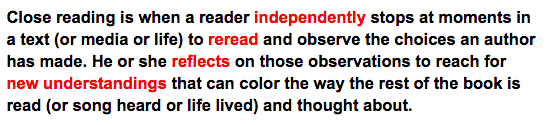
     For a reader to independently stop and reread for meaning, they have to be independent readers in the first place.  That is why the Shared Reading block is a great place to attempt creating habits of close reading for our littlest readers.  Our first grade teachers have a shared text that they read every day for 10-15 minutes outside of the workshop block.  Most often, by the end of the week, most of the students can go back and reread the text for a specific purpose.  If they can do that, we have the very beginning habits of close reading. 

     But, let's think about it for a minute... Why do 1st graders need to close read?  They are still learning how to read?  Right?  

     Close reading is about NOTICING details and thinking about them.   It is about creating meaning in the texts we read, with meaning that is relevant to the reader.  So how can we help our emergent readers notice details, think about things, and create meaning from what they read?  My answer has always been to close read images.  By using pictures with our K, 1st and 2nd graders, we can get them to think deeply about a text, but remove the challenge of finding a text that is deep enough to really think about that they can actually read.
***We can use pictures beyond K-2, too.  Trust me.  I have.

     So, when +Julianne LaFleur came to me to ask how she could enhance her Shared Reading block, and they were beginning their character unit, the words MO WILLEMS practically fell out of my mouth.  What better characters to explore, with the focus on feelings, than the always expressive Piggie and Gerald!  

     I had been to a workshop at Institute Day where +John Fontanetta presented a lesson from the Library of Congress where we close read just the eyes of a famous historical figure.  We had to describe the man, just based on his eyes, draw the rest of him, and then were given his full image as well as historical documents about his impact on history.  


     Since that very day, I have been waiting for +Julianne LaFleur to ask me this question.  I have really wanted to do this with Gerald.  And now we have!

     I took I'm a Frog! and copied about 15 pictures of Gerald.   I then cut out just a rectangle around the eyes, and slightly enlarged them on a white sheet of paper.  I then went back to Miss LaFleur (and +Sarah Berry was there with us that day) and showed her the copies.  I then asked, "How do you want  to scaffold this to your students?"  Let the collaboration begin!  We talked about reading other Piggie and Gerald books first to generate emotion words about the characters, having the students show emotions on their own faces to "feel" their facial expressions, and then of course passing out the Gerald eyes of an unread book as we had planned.

     The best part of it all?  Miss LaFleur came to the team planning meeting the next week, shared the resources, and gave them lesson plans to use over the week during shared reading.  She shared the experience with her team, so they were all able to do the lesson with their classes.  That also meant that I got to see it happening in more than one room!  


     On the first day, I walked into +Jodi Meyer's room, and she had just read Waiting is Not Easy! and generated a list of emotion words to describe Gerald.


     On day 2, I walked into Mrs. Meyer's class after they had read Elephants Cannot Dance.  She had them meet with a partner, and add a new word to their emotion chart.  She had each team share their word, but also had them tell where in the story Gerald felt that way, and why.  Was it in the beginning, the middle, or the end of the story?


     On day 3, I think Mrs. Meyer had them practice showing the feeling with their partner and a new book.  Miss LaFleur had her students, who have iPads, use Popplet to make a web of emotions about characters.  They chose a character from their own books, and used the illustrations to generate the emotion words.   The one above about Piggie even shows the evidence in the illustration, like "his eyebrow is up."

     On day 4, they finally got the pictures of Gerald's eyes!  First, they generated the words to describe him.  In Mrs. Meyer's room, she had them write a sentence about why they thought he might feel that way.  In Miss LaFleur's room, she had them add a setting around him, and then added a speech bubble to have them infer what he might say.


Here are a few videos from when they first started drawing:

     In Miss LaFleur and Miss Alper's class, she had them do a gallery walk to match their drawing with the full image of Gerald.  She laid them all in a line, and had the partner pairs put their drawing above/below the picture they thought it matched.  She did this after she modeled how our faces show expression, of course.  :)


     In the end, they did not all find the exact match to their image.  Some of his eyes were very close to the eyes in another image.  But, for the most part they were close.  Sometimes, the emotions they identified hit the target.  Sometimes, they did not.  But, they definitely are noticing a new detail now! Facial expressions are a huge clue into how a character is feeling.  


My take aways from this?

1.  Mo Willems is a genius.

2.  A Library of Congress lesson on close reading images can be adapted to a primary classroom.

3.  First graders need to focus on learning to read.  However, if we want to add some close reading habits, like rereading for a purpose (emotions) or using images (like illustrations in picture books) then the kids will have a blast while thinking a little deeper.

4.  This series of shared reading lessons hit multiple CCSS standards.  RL.1.3 and RL.1.7 are the biggest, but the incorporation of narrative elements, dialogue, partner work, reading multiple books about the same character, and fluency immediately includes more.

5.  MY BIG TAKE AWAY?:  The Common Core tells us what to teach, but not how to teach it.  I have said that many, many times.  I think that just by watching this seed idea grow in two different classrooms in two different ways shows that.  Collaboration with each other not only helps us learn new things, but it also helps us teach each other.  This series of lessons was just a seed idea that grew into something much more.

And, to close, I figure I'd add a fun image my son drew of Piggie and Gerald.  Just because.  :)


The Power of Balanced Literacy

Sunday, November 23, 2014


     In our 2nd year of Reading Workshop in D100, we have really started to find the value of seeing things in more of a Balanced Literacy approach at Hiawatha.  Our days can be really segmented and choppy, teaching 15 minutes of this, and 15 minutes of that, and feeling disconnected and out of sync.  But, if we see all those 15 minute pieces as pieces of the puzzle, things start to "fit" and flow can be found in our days.

     I was recently at a 5th grade ELA planning meeting, and I was struck with just how much more their unit has flowed this time around.  We got through the 1st year of workshop last year, but we were just struggling to get through it all.  Anytime you adopt anything, that is what you do the first time around.  Our kids struggled with the content, we struggled with the content, but we got through it.  The 2nd year is here, though, and with a balanced literacy approach things have gotten easier.

What changes did they make this year?

1.  They have a common read aloud across the grade level.  This has helped immensely when it comes to assessment.  They have used their read aloud (The Apprentice) to design mid book and final assessments around the CCSS standard 3, as well as the Calkins Unit of Study.  

2.  They use their read aloud as their shared reading and close reading experiences.  If we see shared reading and close reading as separate times in our day, like we did last year, they learn the skill, but don't always apply it.  When they hand every kid a copy of the novel, the kids start to see how to apply those lessons while they are actually reading.  Kids started re-reading the chapters on their own during Read to Self!  

3.  They used their read aloud to set up their Reading Response Journals.  What a great way to make them accountable for their listening, and still model the types of entries we hope to see in our journals. 

4.  They are using their current theme, the Renaissance, and their current novel, The Apprentice, to set up their predominant genre: Historical Fiction.  This work is going to set them up for book clubs, for sure!  Establishing the importance of setting in historical fiction through a shared read aloud is a great way for students to really understand the importance of time and place in historical fiction.  

5.  They were also able to build content area vocabulary around their theme.  By using The Apprentice to teach about the Renaissance, it was easy enough for them to build content area vocabulary.  They then used that vocabulary to do short, focussed research writing about the time period.  They also used quick writing ideas, like Wordles, to explore the important vocabulary of the Renaissance.

6.  They use big ideas, mini lessons, and vocabulary from their unit within guided reading.   When I observed a group performing below level, they were still using some of the concepts the class had been introduced to in workshop and read aloud to spark conversation in guided reading.  They used text that was at their instructional level, but elevated the conversation with grade level discussion around it.  


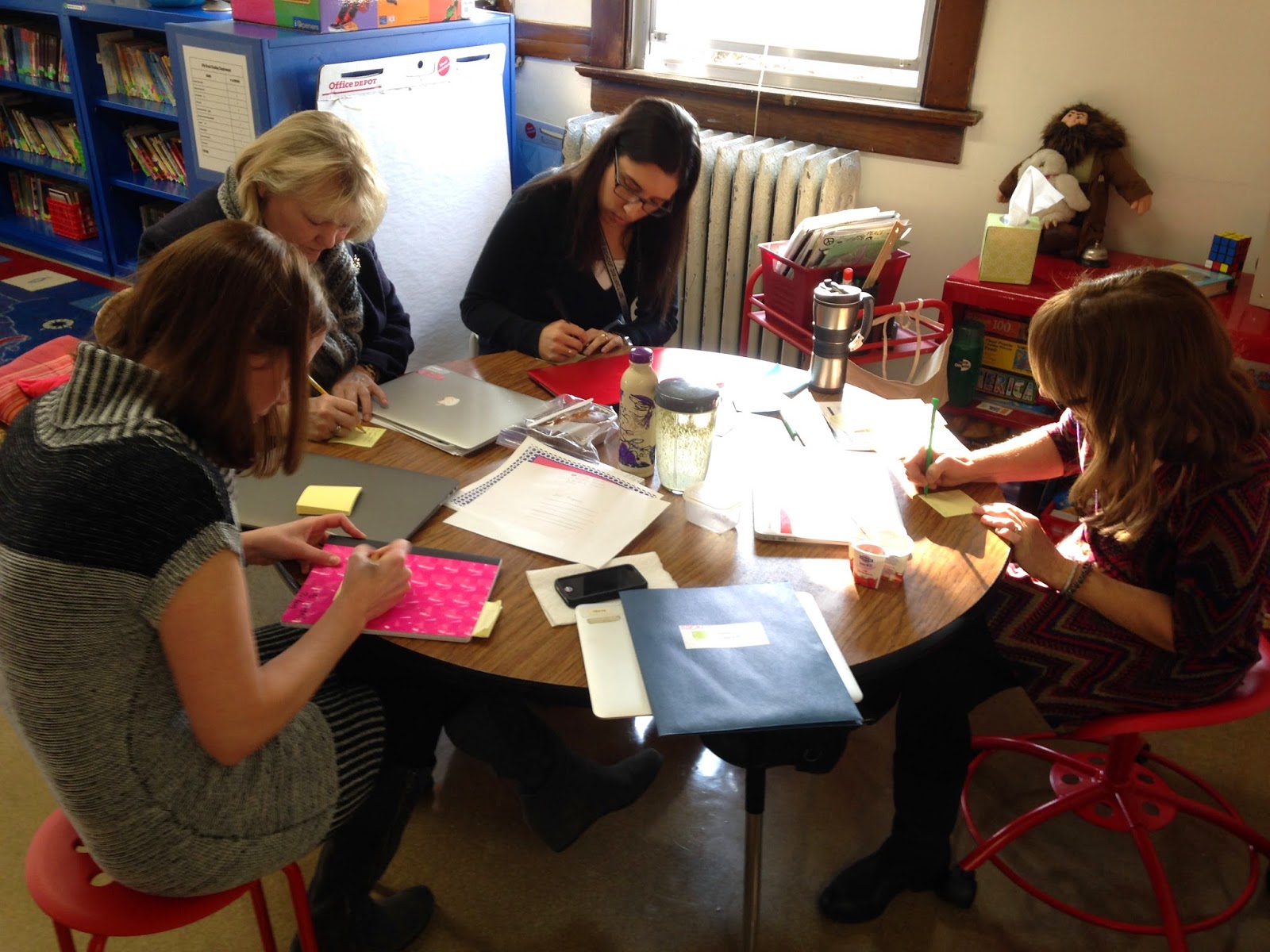
     My favorite moment of the unit so far, though, was when those fabulous teachers practiced a new lesson idea using the book during their ELA plan time.  Kate Cardelli had found a new structure to use post it notes with groups, so they all practiced using post it notes together.  They then realized that they were answering the question as teachers, not their students, and re-did their responses.  What a powerful moment for them!  By using the shared read aloud, they were not only able to talk about a shared text, but they used that text to really think about what their kids are able to do in class.  It is that type of thinking that will really move our students forward.  We have to start where they are at.  Always.


So, what is the one sentence summary of this post?

Use a shared read aloud to help teach the big ideas of your unit, your reading workshop mini lessons, and writing, creating flow in balanced literacy.


Shared Reading/ Close Reading/ ???

Sunday, September 8, 2013

     This week, at 4 different grade level planning meetings, a question arose about shared reading.  While the conversations were slightly different, they all came down to this- What are we supposed to do during shared reading time?

     On our SIP plan, it is written that we have 15 minutes of shared reading time.  It is described here:
This definition of shared reading also incorporates close reading, which is a much more complex type of reading.  Marilyn sent me a blog post about it today, and I thought it was a pretty good read.
Here is the link:
http://christopherlehman.wordpress.com/2013/09/02/blog-a-thon-post-1-what-closereading-isnt-or-at-least-shouldnt-be/

     Why am I sharing this with you?  Because he is right!  Whenever there is a new trend in education, we try to fit the term into our day, assigning a new term to things that we already do.  Shared reading might be something that we already do.  Close reading, however, is not.  I would imagine that close reading will be a new type of reading in most classrooms, and it is a type of reading that our students probably can't do right now.  Before they can tackle that, they need to "run the marathon" a bit more.  They need to get more scaffolding, more guidance, more experience, and more practice.  They need more time.  If we know that, then we can call the 15 minutes that we are doing right now shared reading, and eventually within that time we might get to close read some pieces of the text.

     How can we get our kids into the race?

  • I have been making the suggestion of practicing close reading on photographs or images.  Getting the kids to make observations (use the text details) to infer new ideas (gather meaning from the text) prepares them for the type of thinking that close reading requires.  
  • Use the shared reading time of your day to perhaps unpack the common core standards.  The type of learning that is required in the standards will lead to the possibility of close reading in the future.
  • Model, model, model.  I do, We do, You do.  Remember that if you model some deeper thought now, we might be able to see deeper thoughts from the kids later.  
  • Even though the kids can't really close read just yet, they can do shared reading.  Have it in your schedule now, and as the year progresses so too will the type of lessons you will do during that time.  If we don't reserve the time in our schedule now, we won't have anywhere to put it later.
  • Perhaps use the current shared reading time to build science/ social studies schema using grade level texts.  We have a large ELL population, and giving them shared experiences with background knowledge and vocabulary might be just what they need right now. 
     Remember, don't panic!  We will all get there.  In the meantime, let's keep planning as grade levels on the best way to get to the finish line.  One step at a time...

First Week Shared Reading

Saturday, August 17, 2013

     Now that the first week has arrived, and now that we have clarified what shared reading could be, I am going to share 2 texts that you could use this week with your kids.  There is no pressure to officially do your daily shared reading activities this week, but if you find that you have some time they might be useful.

Click the Titles below to see the actual text!

What Readers Can Do
This text is a mini book by Douglas Wood.  It just talks about some of the wonderful things that reading allows us to do.  It would be a great motivator when trying to set an initial purpose for reading when building stamina.  It could also be starting points for various written responses.  You could have the kids find books in your library that fit the descriptions in the book, or you could use those descriptions to find books for your read alouds.  "You can go back in time to some long ago day, Be a king, be a queen, be a pirate, gang way!"  I bet there are many books in your library that would fit that description.  I scanned the book into a google presentation that can but used on your Smart board, but I do have a class set of them as well that you could borrow.

The First Day of School
This text is a wonderful poem by Judith Viorst.  I used it with my very first class, since I have always loved her books.  I just remembered how wonderful she is after we went to a play at Emerald City Theater 2 years ago to see Alexander.  I could see you using this text with the kids to discuss their fears, but also to write their own beginning of the year poems.  What were they worried about as the year began at Hiawatha?

2013-14 is going to be a great year!

Shared Reading

Friday, August 16, 2013


     This is a screenshot description from our SIP plan about shared reading at Hiawatha.  It calls for 15 minutes of daily shared reading experiences that use grade level text to close read.

     Shared reading was created by Don Holdaway in 1979 to recreate the storybook experience that kids get while reading with their parents at bedtime.  In the primary classroom, shared reading is often done with big books so that all students can see the text and participate in the reading.  Children often chime in when readings are repeated.  It can be done with whole group, as well as small groups.  Shared reading gives the students a safe environment to practice reading with behaviors of proficient readers.  The text is always supposed to be visible to the students, and with SMART Boards is now often shown in digital books.

     In shared reading experiences, the same text is often read for a number of days.  The first read is usually for enjoyment.  Subsequent reads can focus on chanting, predicting, vocabulary, echo reading, etc.  In the upper grades, the teacher should give a focus for reading, and then ask questions specific to that focus.  If you record a shared reading and share it, children will have a fluent model to listen to at another time.  One of the days, close reading is a good option to improve comprehension.

     Since we are following a guided reading model at Hiawatha, students are reading at their individual reading level most of the day.  The idea of shared reading came up as a way to expose children to grade level text in addition to their instructional level text.  The Common Core suggests that students need to move up levels of text complexity, and this is one way to increase their ability to do that.  The Common Core also suggests that students close read text, where they zoom in on small pieces of text and really "dig deep" for meaning.  Shared reading could give students an opportunity to do this, if they can hold the text in their hand while reading and possibly mark their thoughts as they read.

     In short, the 15 minutes of shared reading a day could look like a variety of things.  One bottom line is that all kids can SEE the text, with the best scenario of them having their own copy.  If you merge the two ideas of storybook reading and close reading, as our SIP plan does, there are many texts you can use.  Big books, poems, picture books, novels, short stories, articles, etc., somewhere within the grade level band.  Students could have the text on their computers, and if they use Preview they can mark the text on their screens.  If they use paper copies of text, they can mark their thinking using pencils or highlighters.

     We will be talking more about this as the year goes on, and examples and PD will follow!