What is the Purpose of Grading?

Saturday, November 29, 2014


     Last week, I wrote a post about our staff using the narrative writing standard of the common core and annotating evidence of it on grade level exemplar samples, provided by the Lucy Calkins Units of Study.  You can find that post here.

     Jane DeCaire and I had done that activity to help up get ready for a task that had been assigned by our district Writing Core group.  They had asked that every school pick exemplars of their narrative writing so that we can group them and look at samples from across the district.  In order to do that, we felt that we had to familiarize ourselves with grade level expectations.  All too often, we compare the samples in the room with the other samples in the room, and pick soley based on comparing them to each other.  By looking at the standard and a grade level sample (most of which were more developed than our kids produce), we began to see where the "bar" is.

     For this week, we brought some of our student writing and had the teachers look for evidence of the standard in those samples, and determine what were samples that meet the standard, and if we had any that exceed.  In a previous meeting, we had used these terms to sort work into categories:

1: Below
2: Approaching the standard
3: Meeting the standard
4: Exceeding


We had asked our staff to bring the top 3 samples from their class.  So, is the work they brought a 3 or a 4?


 OR ?

     That seemed to be the question that arose.  We are just getting our feet in the water with standards based grading, and our report cards do not necessarily match the work we are beginning to do with our staff.  So, in my opinion, it comes down to our PURPOSE for grading in the first place.  The great Bob Marzano wrote about it in his book, Transforming Classroom Grading.  Here is a link to a piece of it about purpose for grading.  

He names 5 purposes:
1.  Administrative purposes (promotion, retention, class rank, etc.)
2.  Feedback about student achievement (one of the typical primary purposes of grading)
3.  Guidance (guidance for choosing placement, like a guidance counselor would do)
4.  Instructional Planning (to help determine groups and instructional plans)
5.  Motivation (for the students)

     So which is most important?  Marzano said, "In short, there is no clear pattern of preference across the various sources except for the importance of feedback. Consequently, schools and districts must undertake their own studies of teachers and administrators regarding the purpose of grades." Hey, he must be eavesdropping at our meetings!  :)

     Back to that "Is it a three, or is it a 4?" question...  It depends a bit on our purpose at Hiawatha.  If we are using that 3 or 4 to show whether our students should promote to the next grade, or be retained, then we really need to know what a three or a four is.   Our report cards are not there yet as a district, though, and that is a conversation that really should be held district wide.  

     What if our purpose is feedback about student achievement?  If we look at student work to see if they achieved the learning goals of our lesson, then it is also important to really know what would be considered a 3 or a 4.  If the majority of the class does not get that 3 or 4, should we then use the information to plan for instruction and revisit the missing concepts?  But, if we don't have a clear understanding of what a 1, 2, 3, or 4 really mean, it could be possible for kids in one class to get a 4, and kids in another class to get a 2, for doing relatively the same quality of work.  How do we know what to reteach then?

     What if our purpose of grading includes student motivation, but the 4 is marked for performing at the next grade's standard, and no one in the class can even perform at grade level?  How does that affect motivation?  

     There are many, many, many questions that come up when we start to have conversations like the ones we are beginning to have at Hiawatha.  I really think that all of those purposes for grading are relevant to our conversations as we begin a journey towards standards based grading.  I think the most important factor right now is the collaboration of the grade level teams.  The answer might be different if the task is a pre-assessment, a response journal, a writing sample, or a math problem.  The fact that we are talking with each other, and trying to align our expectations, is critical.  

So, here is a question for your team:
What was your learning goal for the lesson/ assessment/ unit?  What did you expect for them to be able to do?

Perhaps that is your 3.  And it is good to get a 3!  The 4 really should be all that you expect in the 3, but go beyond what was taught to the whole class.  

In short, here are some goals for us as we move forward:

1.  Use the standards in the conversation.  The more we reference the standards and talk about them as a team, the more we understand their potential impact on our kids.

2.  Know that we are in the early stages of this process.  It is OK if, for now, we use this process to just help us decide what to teach next.  It does not have to be about report cards right now.  

3.  Get to know your kids and what they can do.  Move them along to where they can go.

4.  Give yourself permission to figure out your learning goals/ targets and then communicate those to your students with student friendly checklists.  (More on that soon!)

5.  Use our conversations to give better feedback to your students, and less to grade them.  


Thank you, Hiawatha staff, for starting on this journey!   


The Power of Balanced Literacy

Sunday, November 23, 2014


     In our 2nd year of Reading Workshop in D100, we have really started to find the value of seeing things in more of a Balanced Literacy approach at Hiawatha.  Our days can be really segmented and choppy, teaching 15 minutes of this, and 15 minutes of that, and feeling disconnected and out of sync.  But, if we see all those 15 minute pieces as pieces of the puzzle, things start to "fit" and flow can be found in our days.

     I was recently at a 5th grade ELA planning meeting, and I was struck with just how much more their unit has flowed this time around.  We got through the 1st year of workshop last year, but we were just struggling to get through it all.  Anytime you adopt anything, that is what you do the first time around.  Our kids struggled with the content, we struggled with the content, but we got through it.  The 2nd year is here, though, and with a balanced literacy approach things have gotten easier.

What changes did they make this year?

1.  They have a common read aloud across the grade level.  This has helped immensely when it comes to assessment.  They have used their read aloud (The Apprentice) to design mid book and final assessments around the CCSS standard 3, as well as the Calkins Unit of Study.  

2.  They use their read aloud as their shared reading and close reading experiences.  If we see shared reading and close reading as separate times in our day, like we did last year, they learn the skill, but don't always apply it.  When they hand every kid a copy of the novel, the kids start to see how to apply those lessons while they are actually reading.  Kids started re-reading the chapters on their own during Read to Self!  

3.  They used their read aloud to set up their Reading Response Journals.  What a great way to make them accountable for their listening, and still model the types of entries we hope to see in our journals. 

4.  They are using their current theme, the Renaissance, and their current novel, The Apprentice, to set up their predominant genre: Historical Fiction.  This work is going to set them up for book clubs, for sure!  Establishing the importance of setting in historical fiction through a shared read aloud is a great way for students to really understand the importance of time and place in historical fiction.  

5.  They were also able to build content area vocabulary around their theme.  By using The Apprentice to teach about the Renaissance, it was easy enough for them to build content area vocabulary.  They then used that vocabulary to do short, focussed research writing about the time period.  They also used quick writing ideas, like Wordles, to explore the important vocabulary of the Renaissance.

6.  They use big ideas, mini lessons, and vocabulary from their unit within guided reading.   When I observed a group performing below level, they were still using some of the concepts the class had been introduced to in workshop and read aloud to spark conversation in guided reading.  They used text that was at their instructional level, but elevated the conversation with grade level discussion around it.  


     My favorite moment of the unit so far, though, was when those fabulous teachers practiced a new lesson idea using the book during their ELA plan time.  Kate Cardelli had found a new structure to use post it notes with groups, so they all practiced using post it notes together.  They then realized that they were answering the question as teachers, not their students, and re-did their responses.  What a powerful moment for them!  By using the shared read aloud, they were not only able to talk about a shared text, but they used that text to really think about what their kids are able to do in class.  It is that type of thinking that will really move our students forward.  We have to start where they are at.  Always.


So, what is the one sentence summary of this post?

Use a shared read aloud to help teach the big ideas of your unit, your reading workshop mini lessons, and writing, creating flow in balanced literacy.


Narrative Writing Standard Annotating


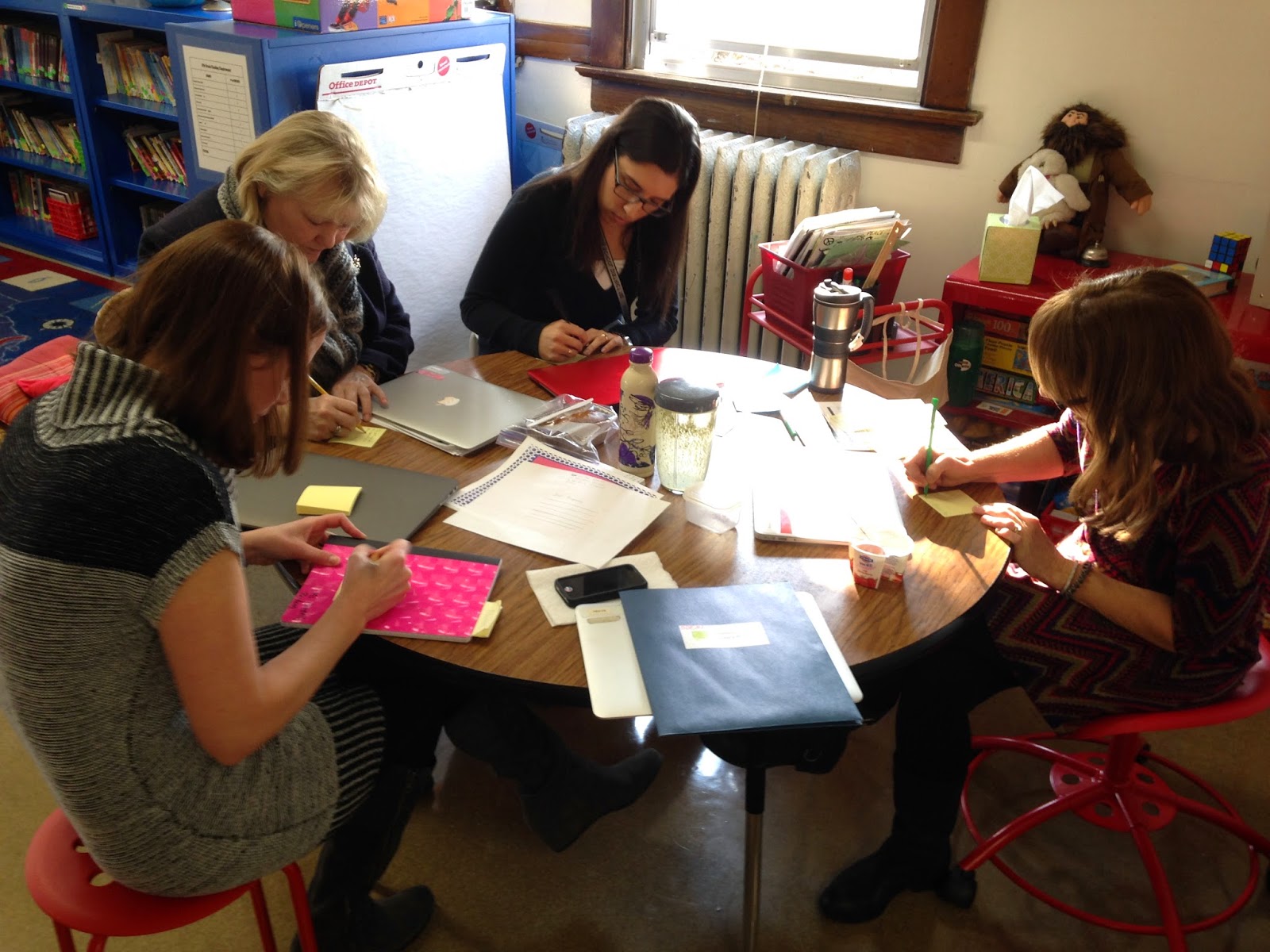
     What are those fantastic teachers looking at so intently, you ask?  Writing samples from the Calkins Units of Study.  They are exploring narrative writing samples in a collaborative effort to find the "bar" when it comes to narrative writing.

     Our school district purchased the Units of Study in writing last year, and this year the Writing Core Leaders are asking that we gather samples of student work that meets or exceeds the standards for every grade, with the purpose of sharing those across the schools as student work examples.  The question is, what does it look like to meet or exceed on the Common Core standard?  It might be easy enough for us to look around our own classroom and pick out the best writing samples, but are those really meeting the CCSS standard?

     In an attempt to find out, we spent a building meeting where we took the on-demand narrative samples from Lucy Calkin's units and blew them up onto a poster.  That way, we had samples that she  feels meets the standard for each grade level, but the story is always a story about a girl named Sarah and her dog.  It was easy to see the progression of writing development from K to 5th grade.

     Before they got started, I had a team member from each grade level get up and hold up Standard 3 from their grade level writing standards.  We could see from where we were sitting just how complex the standard gets as it moves along the grade levels.  We told them to read the standard as a team, and then use the standard and find evidence of it in their grade level writing sample.  Mark it up, code it, etc.


     When they were finished, we had them hang up their writing sample and their standard on the wall.  We then did a gallery walk where they were able to look at the samples across the grades, and notice any patterns and make observations.  


     What did we notice?  Well, our conversation made us aware of a few issues.  Our students still need to work on their volume of writing.  While we have a few students at each grade level who can produce samples like those, many cannot.  We, as a staff, will have to continue to brainstorm ways to increase their stamina and volume.  We also need to focus on purpose and audience when writing within the genre, and less on the small details included on all those checklists and rubrics.  If our students write a great lead, but have no idea why they are writing a narrative in the first place, then they will never create samples like this on their own.  

     Here are the samples, marked up by the Hiawatha teachers.  
*Some grade levels did not finish in time, so they are a work in progress.


Aaaarrgghh! Spider!: A CCSS Anchor Standard 3 Ladder Activity (Part 2)

Saturday, November 22, 2014


     This is part 2 of a blog post, written to describe a series of building meeting my staff and I had in the attempt at unpacking what Standard 3 looks like in our classrooms.  The original post can be found here.

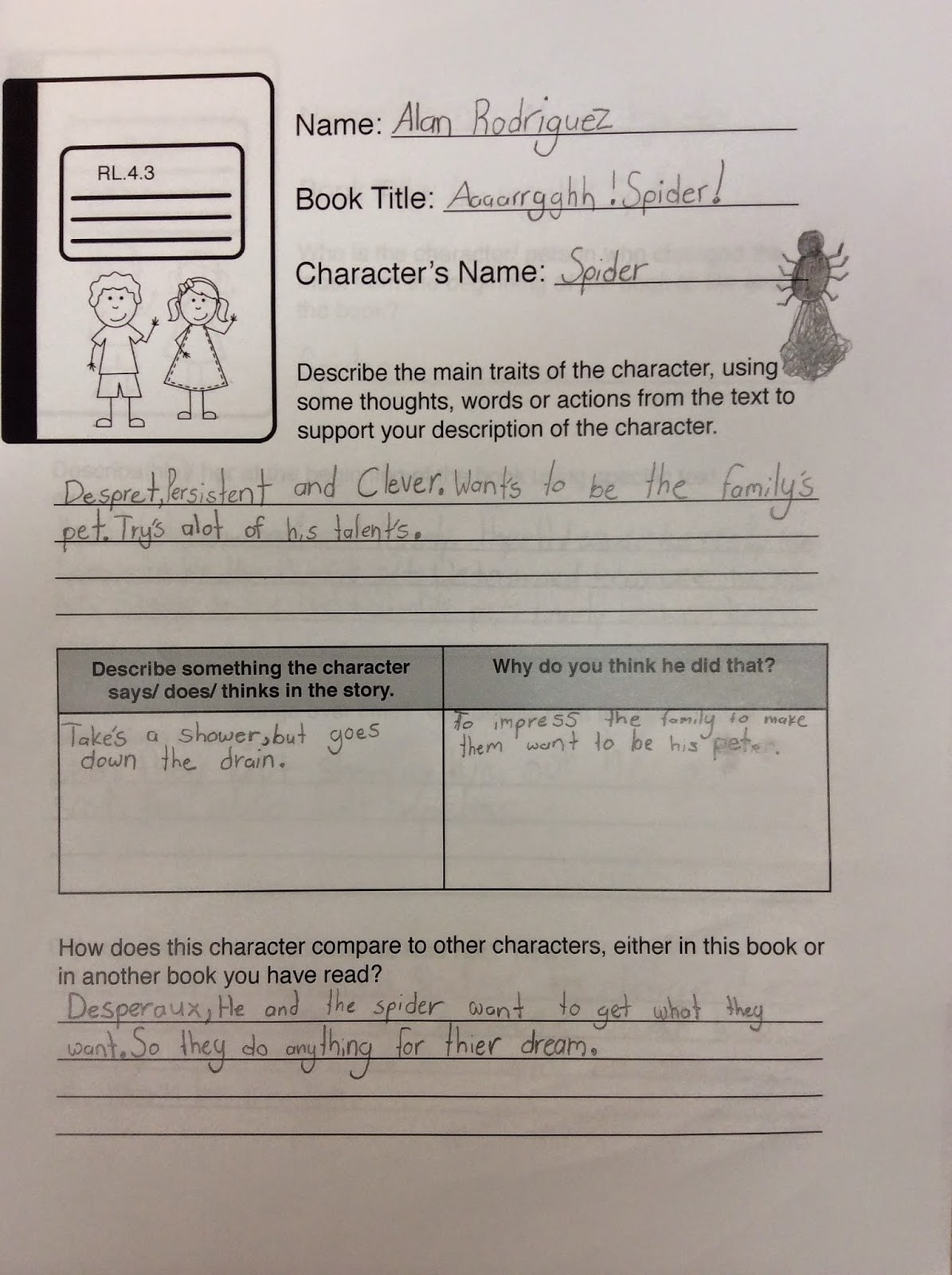
     I started the building meeting reading the story, Aaaarrgghh, Spider! to the teachers.  It is short, and they really couldn't analyze the quality of the students' work if they weren't all familiar with the text.  

     After they read the story, I went through a brief PD on open and closed sorts.   I then asked the teachers to do an open sort of the work done by students in their grade levels.  They could sort the work into any categories that they wanted.  The work began!


     After about 7-8 minutes, we came back together as a group and talked about the process.  I had walked around and listened to the groups as they sorted, and every single grade level chose different categories to sort the work into.  Some did it based on completion of work, others based on if they used text evidence or not, some on overall quality, etc.  Not one team mentioned the work common core standard.  Many of the teams disagreed on what they wanted to sort them as, and therefore didn't have categories in place at the end of the time period.

     I then passed out a rubric that I had made last year about Standard 3 and character development across the grades.  For the second sort, I asked them to use a closed sort, with the four categories below, approaching, meeting, and exceeding the grade level standard of CCSS #3.  They were to use the rubric and the work samples to categorize them.  They got to work, again!


     This time, they all had categories in place and got to sorting the work.  Some chose to sort the sample to reflect the entire page of work, and others chose a single question to focus on while sorting.   I don't think any grade level finished sorting all the samples, and I think it is fair to say that there was still some disagreement about what samples fell into below, approaching, meeting and exceeding.

     So, why do all this?  We spent 30 minutes sorting one written response to a read aloud.  It wasn't even really the best activity to sort in the first place.  Why on earth would we do that?  Well, I think the conversations showed that we do not all have the same "bar" in our minds when we talk about what is expected of the students in our classes.  To be be fair, that "bar" has changed significantly in the past few years.  It is hard for any of us to know for sure what a 2nd grader or a 4th grader should be able to do anymore.  That is why we need to talk about it.  We need to collaborate with each other, and learn these new standards together.  That is the only way that we can ensure that all the students in our building are getting the same education, no matter the room they are placed into.

     I feel like teacher time is extremely precious and limited.  I want to maximize the time we spend together so that it makes the most impact it can on student learning.  The reason I had them do the open sort first, and then the closed sort with the Common Core standard focus, is because I wanted them to see how much more we can accomplish with a clear lens in our mind.  When we collaborate with others, we all bring our own ideas to that conversation.  If we don't focus the conversation in the first place, we might spend a lot of time talking and not a lot of time getting anything done.  The standards can give us a focus that can preserve our precious time.

     Are you curious what we found to be "meeting" in the grades?  Here are some samples.
Kindergarten
1st Grade

2nd Grade

3rd Grade
4th Grade
5th Grade
     This is clearly just a beginning for our building to start to use the students' work to drive our instruction.  We have a clear shorthand in place, though, for common understanding at looking at our student work samples in a range of abilities.  In fact, in the weeks following our building meeting, our ELA plan times began to fill will conversations about the quality of student work along this continuum.  We are beginning to see where they are, and allowing that to help us move to the next step.

Yeah, Hiawatha!!!

1: Below
2: Approaching the standard
3: Meeting the standard
4: Exceeding


Aaaarrgghh! Spider!: A CCSS Anchor Standard 3 Ladder Activity (Part 1)

Saturday, October 25, 2014


     October is here, and that means that I am reaching for one of my favorite books, Aaaarrgghh! Spider! by Lydia Monks.  It is the season for all things creepy and crawly, and a fun book about spiders fits that description nicely.

     Our staff has been working hard at looking at student work to start driving our instruction.  For the past few weeks, we have been using our building meetings to do gallery walks of student work across grade levels, led by our core leaders +Jane DeCaire  and +Christina Betz.  We have simply been looking at work samples (K-5) and noticing commonalities and differences through conversation with each other. Next week, we are going to be looking at reading work, but we wanted to start examining the work at our own grade level more closely to help us make some decisions about where our instruction needs to go.  Time for some formative assessment analysis!

Step 1: Pick a Text

     Formative assessment is really anything that you do with students that you can analyze and use to move your students to the next step in their development.  In order to do a whole staff PD about a possible way to analyze a formative assessment, I decided to create assessments that would walk up the Common Core ladder of expectations for Standard 3.  But what character to study?!?!?

     Spider!

     I love Aaaarrgghh! Spider!  But is my love enough to read it to all 6 grade levels in my building?  Here's why it is:
Kindergarten: Next week, they are reading the Itsy, Bitsy Spider in their nursery rhyme unit.  They 
     also have the word spider up on their October word wall.
First Grade: I had talked to one of our first grade teachers about using this book to help with her 
     Small Moment shared experience story about a bug they found in their classroom.  It can be used 
     to see how some small moments are put together to make a story.
Second Grade:  Our second grade is currently working on adding onomatopoeia and dialogue to 
     their small moment stories.  "Aaaarrgghh!" and "Off you go!" fit perfectly into those lessons.
Third Grade:  Our third grade is currently reading Charlotte's Web.  What better spider to compare 
     than Charlotte?  They even call Spider clever for making her webs, just like Charlotte!!!
Fourth Grade:  They are currently reading Tales of Despereaux, which is about a mouse who doesn't 
     have a family that supports him.  Guess who also doesn't have a family?  Spider!  
Fifth Grade:  They also just wrote a shared experience small moment story about Haunted 
     Hiawatha. Their writing samples were filled with onomatopoeia, and filled with fear (even if the  
     fear in Aaaarrgghh! Spider! is on a much friendlier level...)

Step 2: Create the Assessments

     Once I had a book in mind, I opened the Common Core rubrics I made for Standard 3 across grade levels and really thought about what would be expected of our students to do with the book based on the CCSS.  I then opened a blank Pages document and got to work.  The assessments I made focus on key components of the grade level standards, but are certainly not complete and can be measured in other ways as well.  But, for the purpose of my assessments, they reflect the work of the CCSS standards across each grade.

     Here are the assessments.

Step 3: Go into the Classrooms!

     I then went into one classroom as each grade level in my building.  Thanks, +Kara Wesolowski+Jodi Meyer+Margaret Daly+Christine Flowers+Lori Horne, and +Katie Cardelli for letting me come in to read to your class!  

     I started by walking them through the character assessment, using a character that they have been following in their read alouds.  Using No, David, Arthur, Charlotte, Desperaux, and Rob from Tiger Rising, we had a brief conversation touching on the kinds of character analysis that their standards expects by the end of the year.  I used a familiar character to set up the expectation, and then told them that they were going to do the same work using a new character.  Enter Spider!

    Once the kids were working independently on the assessment, I did leave them alone to work and their teacher and I took some time to talk about the questions I used on the assessment, and to start to look at the early responses as they came in.  This gave me some time to talk through my rationale for the assessment so that the teacher could lead the sorting for their grade level at our building meeting. I also didn't want to offer the kids too much support, because we are going to sort it into categories to help us guide our instruction.  If I provided a lot of support, it might skew the sorting and cause a child not to get the feedback or support they need.

     Here is a video of me reading the book.
(I made the video so that the staff who didn't hear me read it would be able to listen to the book before our meeting.  My kids helped me out, and the mic went in and out, so it is not Grade A quality, but it is helping me flip our meeting a bit.)

Step 4: Sorting the Work

     The whole point of doing this was to collect samples that the teams could sort.  That will be covered in Part 2, sometime after our building meeting next week!

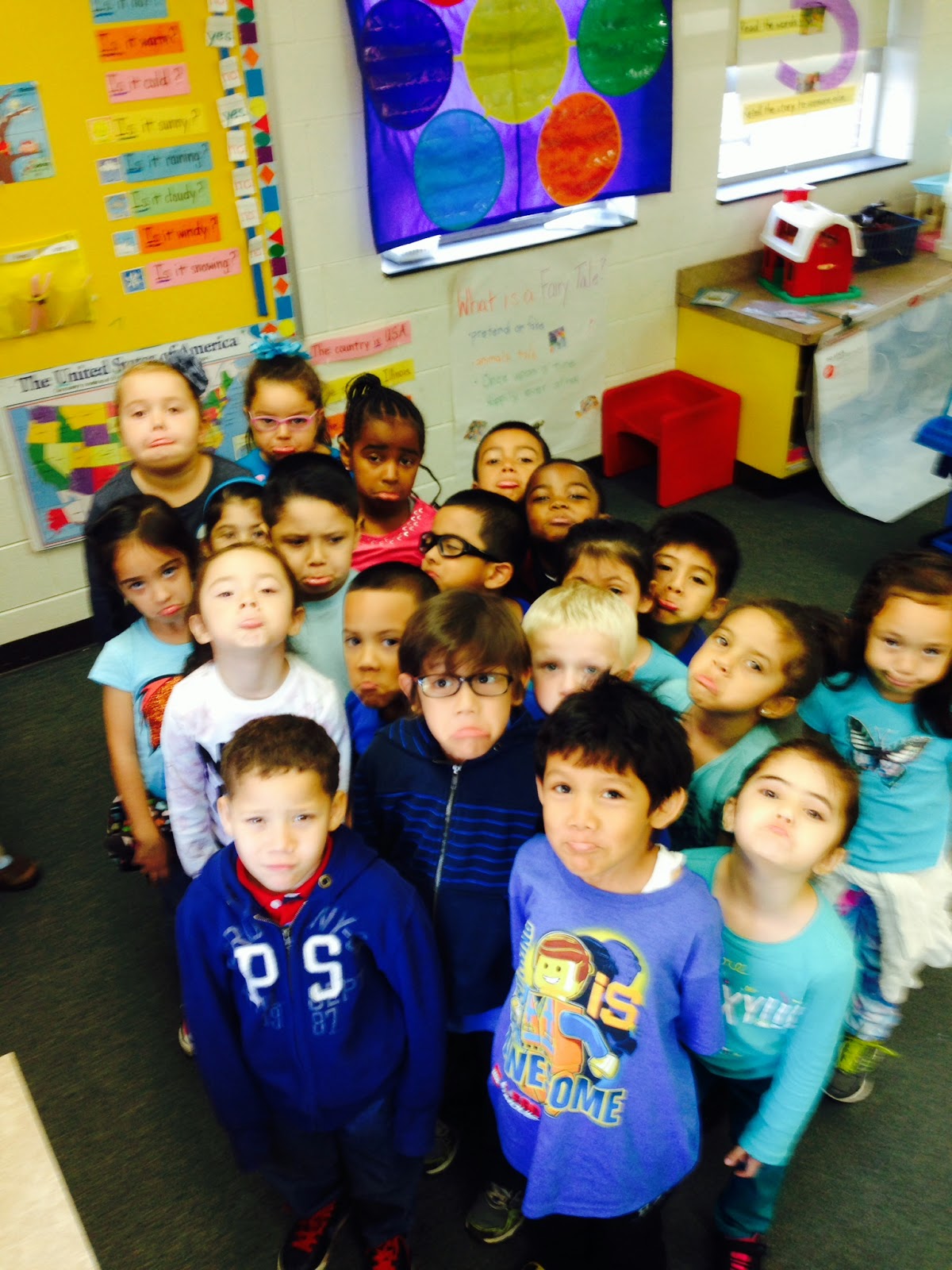
     Stay tuned for completed work samples and thoughts about sorting student work into categories in grade level teams.  Until then, here are some pictures of our cute Hiawatha kindergartners showing us the emotions felt by Spider at three points in the book.  


Feedback is...

Friday, October 24, 2014

     We keep hearing that word... Feedback.  But what is feedback?  Is it a "Great job!" or a high five after a job well done?  While we all want positive compliments and praise, feedback is a little more that that.  I have been collecting ideas from Twitter posts and blog entries that I have read, and decided to compile them into a quick list to help me better define what good feedback can be, both to students and staff members.

Feedback is...

  • timely, relevant, and action oriented (John Hattie)
  • personal and fast!
  • not about the person (as a person)
  • given during lessons, or very soon after
  • practical
  • a resource that allows students to take active steps to advance their own learning (Margaret Heritage)
  • non-evaluative
  • related to learning goals
  • an opportunity to revise work and deepen understanding
  • a teaching opportunity
  • collaboration, not correction
  • a formative assessment
  • not advice
  • information that includes what works and why
  • not praise
  • not about right or wrong
  • feedback towards the summative assessment (Wiggins)
  • based on student strengths
What am I missing?  Leave me a comment and let me know!
RISE Model by Emily Wray

Anchor Chart Walks

Sunday, October 19, 2014

     Every other Friday, I like to take a walk around my building and snap pictures of all the new anchor charts up in the classrooms.  I start in kindergarten, and make my way to 5th grade.  I take pictures of reading and writing charts, as well as math charts.  I then upload them all to Google and put them in a gallery that I share with my staff.  I have 2 goals in doing this every other week.

1.  The teachers in my building get to show off their charts, and give ideas to us all.  It is like going to Pinterest, but all the charts are Hiawatha's own.

2.  My primary reason is to give the classroom teachers a glimpse into the instruction of the other classrooms in our building.  It takes a village to educate a child, but we don't often get to see what everyone else is working on.  This gives them a glimpse into the learning going on down the hall.

This week, I wanted to give some shout outs to some things I was extremely excited about.

Character Traits with Mentor Texts!


     I was really excited to see that many of the anchor charts that involved character traits/ feelings included real characters!  Last year, we made a lot of charts with lots and lots of traits listed.  The kids, however, didn't really know what they meant.  Their limited vocabulary left them confused at what some of those traits really meant.  This year, by introducing the traits through characters, the traits they used will be a lot easier to transfer because they have a reference to compare it to!  Some of the charts were from novels the class was reading, and some were just from a read aloud from the week, but all are specific to real characters in real books!  

Experience Charts!


     Many of our students lack the life experiences they would need to really use a wide vocabulary when writing.  Our first grade classrooms solved that with doing their pumpkin writing after taking a trip the the pumpkin farm.  Not only did they go on the trip and take pictures of their adventures, but they also carved a real pumpkin to generate adjectives to use when writing.  The first graders generated those words all on their own, with a little help from a real pumpkin and some great teachers!  I can't wait to read their writing samples!

Learning Targets!


     OK, this one might be cheating.  But, boy was I excited when I saw this.  It isn't really an anchor chart, but I will throw it in anyway.  This first year teacher (yep, first year!) writes her Learning Targets each day and the class reads them at Morning Meeting.  Not only does this help those little first graders prepare for the day, but I am sure it helps Ms. LaFleur remember exactly why she is teaching what she is teaching every day.  That little bit of thought about targets can really make learning purposeful.  

Craft and Structure Examples!


     Our students have traditionally struggled with the craft and structure Common Core Standards (4-6) when given the F&P test, as well as in reading and writing workshop.  This anchor chart in Ms. Cardelli's 5th grade not only gives students some real examples of how to show, not tell when writing, but it also gives them a little checklist for students to look at when they are drafting.  Perhaps the examples will also help them pull out language from the books they read independently as additional examples, too!  

Check out the rest of of fabulous charts here!